

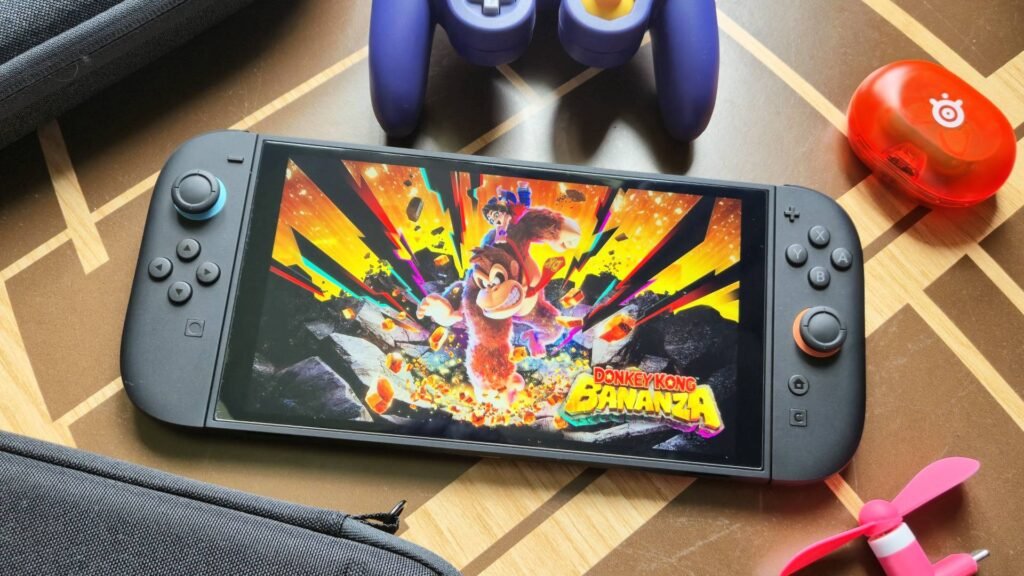
In a world of rapidly evolving technology, the video game industry is undergoing radical transformations that are reshaping the competitive landscape. Today, industry giants stand at a crucial crossroads: while Nintendo prepares to launch the next generation of its legendary console, Sony is strategically moving to solidify its dominance in the high-definition gaming market. This clash between two contrasting philosophies – fun and innovation on one hand, and power and superior performance on the other – is shaking the foundations of the industry and shaping the future of interactive gaming.
Nintendo Switch 2: A Hybrid Revolution
Nintendo is preparing to launch the Nintendo Switch 2, which is expected to be a qualitative leap, not just a technological upgrade. Speculation suggests that the new console will combine immense performance of up to 4 teraflops in streaming mode with a 1080p OLED screen when used as a handheld device, and the ability to display games in 4K resolution when connected to a TV. This technological leap aims to bridge the processing power gap of the original Switch, without abandoning the core philosophy that made the first console a global phenomenon: flexibility and portability.
But the real innovation may not be in the specifications alone, but in the user experience. Leaks suggest that Nintendo is working on improving the Joy-Con to reduce lag issues and adding new haptic feedback and smart vibration features. The operating system is also expected to be faster and more stable, with better support for cloud services and digital games.
The most exciting strategy is integration with the Switch’s vast library. The new console is expected to support all previous-generation games with performance and resolution improvements, making the transition seamless for millions of existing owners. This strategic decision protects gamers’ investments and ensures a massive user base from day one.
Sony: Fortifying the Empire
On the other side of the arena, Sony is moving swiftly to solidify the PlayStation 5’s position as a bastion in the world of high-definition gaming. Despite the platform’s immense success, Sony faces multiple challenges: fierce competition from Xbox, the rise of mobile gaming, and a shift in consumer habits toward subscription services.
Sony’s response comes on several fronts. First, it’s investing heavily in exclusive games with deep storylines and cinematic experiences, developing new installments in successful franchises like God of War, Horizon, and Spider-Man. Second, it’s enhancing its PlayStation Plus service with multiple tiers offering hundreds of classic and modern games, aiming to remain competitive in the cloud gaming market.
Most importantly, Sony is pursuing an innovative expansion strategy. Acquiring multiple development studios, investing in adapting its games into successful series and films (as seen with The Last of Us), and launching peripherals like PlayStation VR 2 are all steps aimed at transforming PlayStation from a mere gaming platform into a comprehensive entertainment ecosystem.
A Battle of Philosophies: Fun vs. Power
This clash of giants is more than just a competition for market share; it’s a battle between two distinct philosophies of the gaming experience. Nintendo remains true to its “fun first” motto, creating unique gaming experiences based on creative interaction, social play, and family fun. A console like the Switch 2 represents a continuation of this philosophy, adding the technological power that allows developers to fully realize their visions.
In contrast, Sony places visual power and cinematic experiences at the heart of its strategy. The PlayStation 5 and its successors represent the pinnacle of home gaming technology, with a focus on realism and emotional depth in storytelling. This philosophy appeals to gamers seeking immersive, cinematic experiences and establishes PlayStation as a benchmark for quality and technical excellence.
The Wave’s Impact on the Industry
These developments are creating shockwaves across the entire gaming industry. Independent developers find the Switch 2 an ideal platform for their innovative games, while AAA studios leverage the power of PlayStation to push the boundaries of technical possibilities. This competition is also accelerating the adoption of new technologies such as ray tracing, artificial intelligence in game development, and cross-platform integration.
Other competitors, especially Microsoft with Xbox, are forced to adapt their strategies to stay in the race. We might see new alliances, new players entering the market, or even shifts in traditional business models. Ultimately, the biggest beneficiary is the gamer, who gets more diverse choices, higher quality, and more competitive prices.
An uncertain but bright future. As Nintendo prepares for the Switch 2 earthquake and Sony fortifies its empire, the biggest question remains: can these two different models coexist and thrive? History suggests that the gaming market is large enough to accommodate multiple philosophies. The success of the original Switch, alongside the PS4 and Xbox One, proved that gamers seek diverse experiences that cater to different needs.
The future may not belong to the sole “winner console,” but rather to a multifaceted ecosystem where people play on different platforms depending on their mood and available time. We might see more convergence between platforms in online services and cross-platform gaming, while each retains its unique identity.
The current earthquake in the gaming industry isn’t destroying the foundations; it’s building a new, more diverse, and exciting landscape. Whether you’re a fan of family fun on Switch, looking for immersive cinematic experiences on PlayStation, or following the battle as an industry observer, the coming years hold the promise of gaming experiences that will change our concept of interactive entertainment.






Leave a Reply